top of page

A progressive core conditioning system for horses. The specially designed saddle pad and equine physio bands encourage hindquarter engagement and better use of the back — without restricting the horse’s head and neck. 


How do Equine Balance Bands Work?

The abdominal and hindquarter training bands support the core and provide gentle, non-restrictive contact during groundwork, lunging and ridden exercise to develop and strengthen the core muscle groups, helping the horse to achieve improved balance, posture and performance.

Equine Balance Bands for Rehabilitation and General Exercise

The Equine Balance Bands System is a popular adjunct to many equine rehabilitation exercise plans

Vets and physiotherapists world wide recommend the saddle pad and resistance band system for equine rehabilitation from kissing spines, sacroiliac, hind and fore limb issues.

Equine Balance Bands are suitable for all training stages.

Training is beneficial not only to horse's recovering from injury, but it also helps to reduce the risk of injury and unsoundness in all riding horses including young horses, older horses and performance horses.


Equine Balances Band Complete System includes an additional set of replacement bands currently discounted with 50% off RRP).


Equine Balance Bands Core Conditioning System | Two Sets of Pro-Grade Bands

£105.00 Regular Price
£90.00Sale Price
No Reviews YetShare your thoughts. Be the first to leave a review.
24320.png
Copy of Copy of PRODUCT SETS_20260929_151630_0000.png
Copy of Copy of PRODUCT SETS_20260929_150539_0000.png

ENGAGE THE CORE AND HINDQUARTERS 

IMPROVE POSTURE AND BACK STRENGTH

EQUINE REHABILITATION

CONDITIONING AND INJURY PREVENTION

Supports long-term soundness by developing core strength and body awareness.

Helps promote correct posture and alignment for biomechanical efficiency and comfort 

A progressive system to build strength, stability and resilience during all training stages

Encourages the horse to work 'through' with abdominal and hindquarter muscle engagement.

(1464 x 600 px) AMAZON A+ Image desktop (1464 x 600 px) (73).png

How do Equine Balance Bands Work?

Scroll left / right

Core Bands for Equine Training and Rehabilitation

By encouraging core engagement and flexion behind, the bands help the horse to lift through the back and move in better balance.

AMAZON A+ Image desktop  (463 x 625 px) (25).png
AMAZON A+ Image desktop  (463 x 625 px) (22).png
AMAZON A+ Image desktop  (463 x 625 px) (21).png
AMAZON A+ Image desktop  (463 x 625 px) (24).png

Equine Balance Bands Support Progressive Horse Training

Develop suppleness and strengthen the body.

Transfer ground skills to riding under saddle.

Build solid foundations from the ground up.

Improve muscle tone and fitness.

(1464 x 600 px) AMAZON A+ Image desktop (1464 x 600 px) (89).png
Which Horses can Benefit? 

Core conditioning strengthens and stabilises the body. Allowing the horse to re-balance, work over the back and carry the weight of a rider with increased comfort, ease and agility. Ideal for schooling, re-schooling and rehabilitation.

TRAINING THE PERFORMANCE HORSE

RE-TRAINING INCLUDING EX-RACE HORSES

YOUNG HORSE DEVELOPMENT

EQUINE REHABILITATION

Scroll left / right to view more

A Complete Core Conditioning System 

Contoured Saddle Pad

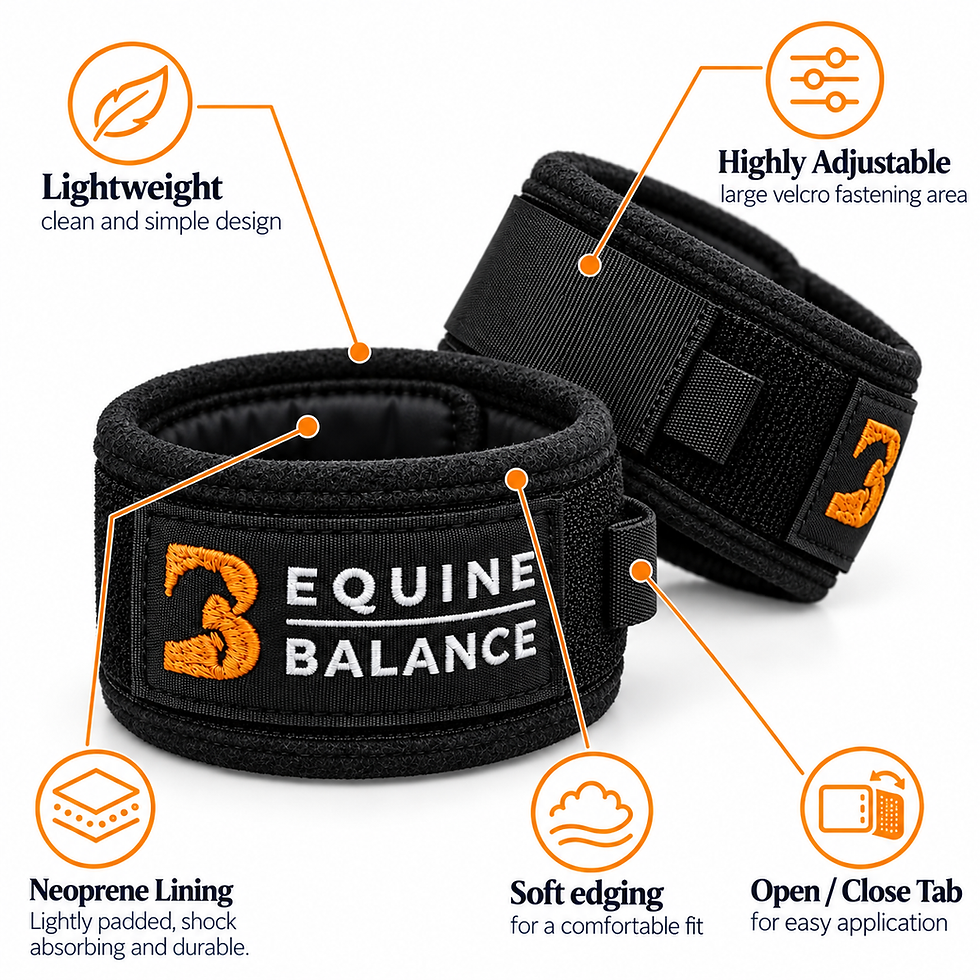
Pro Grade Equine Physio Bands

Three carefully designed elements, working together to support posture, strength and progressive training

Core Conditioning EBook

Shaped for resistance band training. The ergonomic design relives pressure over the spine and withers whilst providing a secure attachment point for the Equine Balance Bands. 

Designed in collaboration with veterinary and physiotherapy providers. Equine Balance Bands are formulated to provide optimum neuro stimulation levels.

Scan the QR code inside your Equine Balance Bands package to access the e-Book on mobile or desktop

Rotating Premium Laptop Product Video (5).png

Suitable for high withers

Moisture wicking lining

Rotating Premium Laptop Product Video (4).png
Rotating Premium Laptop Product Video (11).png

Military grade plastic buckles

Reinforced girth guard

ChatGPT Image Oct 1, 2026, 01_34_08 PM_e

Supportive body contact

Secure fit and non-slip texture

Durable, wipe clean finish

Genuine Equine Balance Bands®

Rotating Premium Laptop Product Video (9).png

About resistance band training for horses

ChatGPT Image Oct 1, 2026, 01_34_29 PM_e

How to fit Equine Balance Bands

Rotating Premium Laptop Product Video (3).png
Rotating Premium Laptop Product Video (13).png

Getting started and preliminary training

Further training and progression

(1464 x 600 px) AMAZON A+ Image desktop (1464 x 600 px) - 2026-10-27T161527.148.png


Band Size Guide

Designed to give the perfect fit for every horse and discipline in English and Western styles

Scroll left and right for sizing and style information

You may also like

Additional products - allowing use on multiple horses, with different style or size needs

Frequently Asked Questions

More information including research findings, fitting advice and band care tips 

Has scientific research been conducted on resistance band training for horses? Yes. Several scientific studies have investigated the effects of elastic resistance bands on equine movement, abdominal muscle activation and back stability. One of the systems used in published research is the **Equiband® Pro System**. A study by Pfau et al. (2017) reported changes in thoracolumbar movement consistent with increased dynamic back stability during trot. Another study by Ellis et al. (2023) examined the Equiband® system in eight horses with mild hindlimb lameness. Researchers reported improvements in certain measures of movement symmetry and postural stability, although lameness itself did not significantly improve. Equine Balance Bands are a separate product designed for progressive core conditioning. These studies were not conducted using Equine Balance Bands, and their results should not be assumed to apply directly to our system. **Scientific references:** [Pfau et al. (2017) – Equine Veterinary Journal](https://doi.org/10.1111/evj.12690) [Ellis et al. (2023) – Journal of Equine Rehabilitation](https://doi.org/10.1016/j.eqre.2023.100003)

bottom of page